

Permaculture Design Course – Illinois
COURSE DESCRIPTION:
We live in an era where many consider a connection with the land in a self-sustaining way as not only desirable but vital. The Three Epochs of Humanity PDC Course explores the creative and experiential application of life-skills passed down by our ancestors into the present time and beyond. At the end of this course, students will be able to perceive and utilize that which is available in their immediate landscape in a conscious and ecologically-astute manner.
The aim of this course is to prepare students with a unique and comprehensive lens to approach design work, equipping them with the necessary tools to perceive and elucidate the “Genius of Place”. This course pulls from multiple disciplines and includes a variety of local instructors, each offering a unique vision of a comprehensive, ecologically-based lifestyle.
Students will learn from the ground up, exercising their creative will through a series of interactive presentations and hands-on activities in order to understand the principles of climate, landform, water systems, access and circulation, microclimate, plants and animals, the built environment, zones of use, soils and fertility, the cultural, economic, social, political and spiritual spheres, and more.
Students will be immersed in living history, where knowledge and hands-on skills come together to form an integrated and balanced perspective.
Epoch I: Hunter-Gatherer – Permaculture as Seen Through the Eyes of the Hunter-Gatherer
Epoch II: Settlement – Agriculture & the Built Environment
Epoch III: Urban & Suburban – Appropriate Technology & The Ecological Epoch
COURSE INFORMATION:
DATES: July 26th-August 3rd (9 days total)
COST: $775 USD
Includes: full course access, 3 meals per day (organic & local foods)
***COURSE LIMITED TO 20 STUDENTS***
LOCATION:
The Center for Lost Arts
7140 Old Hwy 51 N, Cobden, IL 62920
LODGING:
Center For Lost Arts has some shared lodging on site and access to a large vintage cabin 4 miles away. Camping is free.
Go to: www.centerforlostarts.org and follow links to Airbnb & Tiny Home rental to see photos.
After viewing, contact CFLA director,
Bonnie Burton (Contact for Lodging):
Phone: +1 (618)-713-1975
Email: centerforlostarts@gmail.com
PLEASE CONTACT FOR MORE INFORMATION:
Wayne Weiseman
Phone: +1 (618)-713-0537
Email: permacultureproject@gmail.com
Course Setting:
The Center for Lost Arts in Beautiful Southernmost Illinois
Southernmost Illinois is a place with endless adventures and activities to enjoy – hiking, biking, kayaking, canoeing, swimming, rock climbing, music festivals, farms, vineyards, breweries, interesting shops, artists, artisan markets, and tours. There are many people striving to keep the Shawnee National Forest and surrounding lands pollution and trash free. Thanks for helping out.
In 2016 Paul and Bonnie officially founded the Center For Lost Arts which currently includes: Eva’s Roost, Tiny House of Paul, House of Paul (main house), Paul’s woodshop, the greenhouse, the gardens, forest and pond, the strawbale house and Cobden Village Shops. All guests, helpers and participants have access to 20 plus acres of property with native trees and gardens, wandering trails and a beautiful pond.


The land that Center For Lost Arts inhabits, was part of a 400 acre tract of land, originally given to a settler family in the late 1800’s. Eventually, the land was divided and in 1985, Paul became the most recent owner of 20 acres of farmland, a barn and a pond. “We consider ourselves stewards of this land now and are happy to share it with visitors and guests. All are welcome here.”
It would be remiss if we did not acknowledge the indigenous people who lived on and traveled through the land of Southern Illinois for 12,000 years before being forced to leave. The “Inoca”(or Illinois as the French explorers and missionaries called them) may have consisted of as many as 12 different Illinois tribes at one time, but by the end of the century, seven of the tribes had disappeared: the Chepoussa, Chinkoa, Coiracoentanon, Espeminkia, Maroa, Moingwena, and Tapouaro. Five principal tribes survived into the 1700s: the Cahokia, Kaskaskia, Michigamea, Peoria, and Tamaroa with the latter two continuing into the early 1800’s. As you travel through the area, you’ll see location names honoring these tribes.
Learn more about the Center for Lost Arts, Bonnie, and Paul at:
COURSE OUTLINE:
*Please Note: This is a full nine-day course leading to a Permaculture Design Certificate (dawn to dusk every day).
- Because of limited time we will focus our hands-on learning activities on the essential aspects of each epoch, adjusting our schedule to suit day-to-day conditions and the needs of the students.
- The structure of the course will follow the history of humanity through three great epochs: Hunter-gatherer, Settlement, and Urban/Suburban.
- All students must complete a final design project and presentation for course graduation, as detailed below.
- Includes 2 site visits to local farms: All-seasons Farm & Flock Farm
- Includes a variety of local instructors.
Epoch I – Hunter-Gatherer: Permaculture as Seen Through the Eyes of the Hunter-Gatherer
The hunter-gatherer relies on his/her ability to read the lay of the land and to gather what is needed. Food, fibers, building materials, water, etc., are gathered and utilized for sustenance, warmth, and pleasure. This segment of the course takes place outdoors.
Course components include a selection of hands-on activities and discussion from the following topics:
- Studying regional native traditions and ways of life
- Wildcrafting
- Plants: field identification, conscious harvesting practice, food preparation, preservation and storage, herbal medicine, edible, medicinal, utility functions
- Observing and reading the landscape
- Identifying basic necessities (fire, food, water, shelter, and more)
- Creating traps, bows, and arrows; tracking and hunting
- Creating fishing equipment; catching, cleaning and preparing fish for a meal
- Using local materials to construct a primitive village, paying attention to solar orientation, thermal mass and insulation
- Managing the waste stream
- Discussing the invisible social structures of some tribes and tribal customs
- Discussing the origins of agriculture and pastoralism
In this section of the course, we dissect the scale of permanence (climate, landform, water, access & circulation, microclimate, plants and animals, the built environment and energy systems, zones of use, soils and fertility, social, cultural, economic, and spiritual aspects) from a hunter-gatherer perspective – understanding the fundamentals of the natural environment to meet human needs, and learning from indigenous life skills.


Epoch II – Settlement: Agriculture & the Built Environment
This epoch marks the shift from nomadic life to rooted settlement, where humans begin shaping the land through agriculture, animal husbandry, and shelter-building. We explore how to design self-reliant homesteads using natural building, renewable energy, water systems, and regenerative food production. The focus is on aligning the built environment with ecological principles to support both survival and sanctuary.
Course components include a selection of hands-on activities and discussion from the following topics:
- The Permaculture Principles
- Agriculture & Pastoralism
- Crafts, Tools, and Equipment
- Budgeting for the homestead
- Natural Building: Green structures, ecological building practices (Building codes)
- Eco-building construction and home retrofit
- Renewable energy (wind, solar, water, fire) systems and Energy conservation
- Cooling, heating, air purification, and climate regulation
- Biological waste management systems and waste detoxification
- Nutrient Storage – food preservation (food storage, processing, dehydration, fermentation, canning, etc.)
- Creating a Peaceful Sanctuary
- Homestead maintenance, reuse and recycling
- Water collections systems: Purification, Storage, Distribution, & Cycling of Water (redundancy in water management)
- Earthworks for water management
- Soils and Biological Diversity – fertility
- Small Animal Husbandry
- Large Animal Husbandry and Cropping
- Forms of eco-gardening and farming (include Harvesting and Utility Forests (permaculture, biodynamics, biointensive, Korean natural farming, Fukuoka, Jadam, organics – vegetables, fruits, nuts, medicinal and culinary herbs, flowers)
- Plants, trees, and their energy interactions
- Aquaculture, aquaponics, ponds
- Small farm management
Epoch III – Urban / Suburban: Appropriate Technology and the Ecological Epoch
In this phase, we apply permaculture to modern life—transforming urban and suburban spaces with small-scale systems, appropriate technologies, and thoughtful design. We explore how to meet human needs while regenerating ecosystems, integrating tools like mapping, energy systems, bioregional planning, and sacred geometry to reimagine the city as a place of resilience and beauty.
Course components include a selection of hands-on activities and discussion from the following topics:
- Pattern understanding and observational skills
- Application of principles at small scale
- Land use planning: Site suitability, Viewshed analysis, Neighborhood
- Analysis (include the application of specific methods, laws, and principles of design)
- Small-scale bioregional site design-small intensive systems (include the application of specific methods, laws, and principles of design)
- Plants and animals based on scale
- Whole House Agriculture
- Vegetation, land cover, and natural resource mapping
- Appropriate technology for urban-suburban sites: energy, tools, etc.
- Other areas of interest and study:
- Natural medicine
- Planning with sacred geometry and number
- Wildcrafting (continually throughout the course – plants and animals for food, medicine, and utility)
- Clothing
- Recreation
- Art project with natural materials
- Noise Abatement
- Settlement, village life-ways, and folkways
- Map building and modeling (Google Earth, Lidar, drones, etc: creating maps for design)
- Infrastructure and roads
- Food Forests and Forest Gardening
- Communications, Emergency preparations and procedures
- Tools, equipment, resources, and shop protocols
- Management and Maintenance
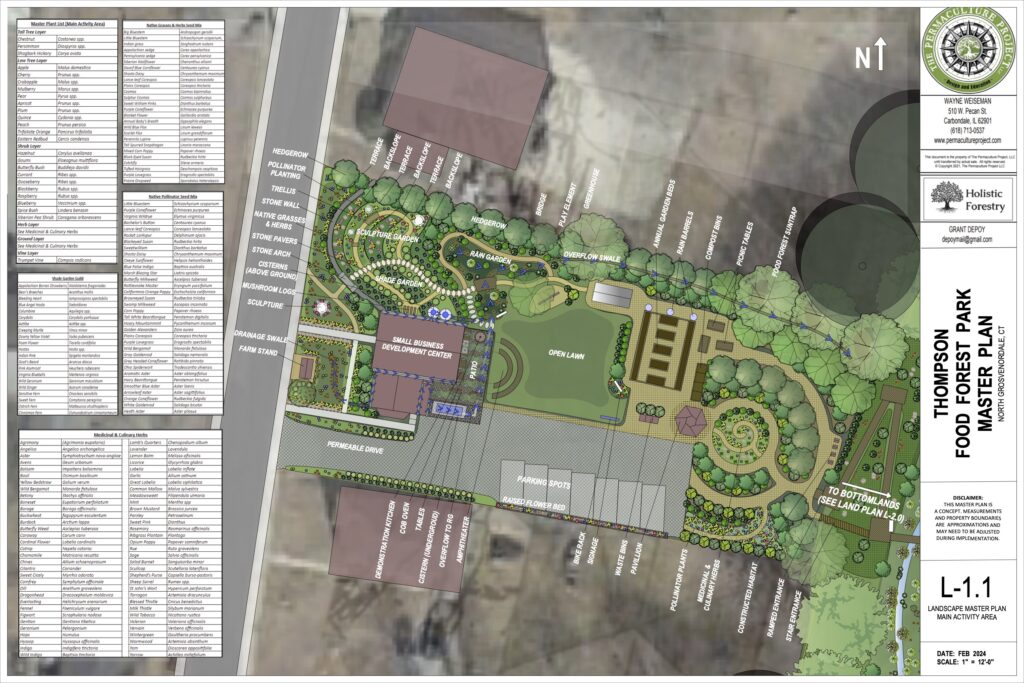


Final Project – Master Plan Presentation
Throughout the course, students will work on a master plan for the Center for Lost Arts and present their designs on the final day.
In order to accomplish the full comprehensive design, we conduct an 4-phase process as follows:
Phase I: Initial discussion, protocols, history of land and inhabitants, land tenure, institutional analysis (businesses), holistic goal, vision, mission, geopolitical assessment, bioregional delineation, values, objectives, goals, needs, wants, available budgets and monies.
Phase II: On site assessment, abiotic and biotic factors, physical, biological and cultural attributes, landform, built environment, energy sources, present and historical land use features, activity nodes and corridors, critical habitat foundations, soil composition, vegetation composition and cover, successional pattern and plant productivity, wildlife corridors, water resources, climatological factors, the waste stream.
Phase III: Design Charrette with representatives of all those occupying and using the site.
Phase IV: Create a master plan: The master plan is a concept map that depicts the needs and ideas of the client, and the designers’ experience in defining what is best for the land and the people that inhabit it.
- Begins with an intensive design charette (see previous) with all stakeholders involved in the project.
- Subsequently, the designers review and collate all materials collected and work them into a master plan.
- This master plan is a precursor to construction drawings and implementation of the project.
- Look closely at code requirements, zoning, for future implementation.
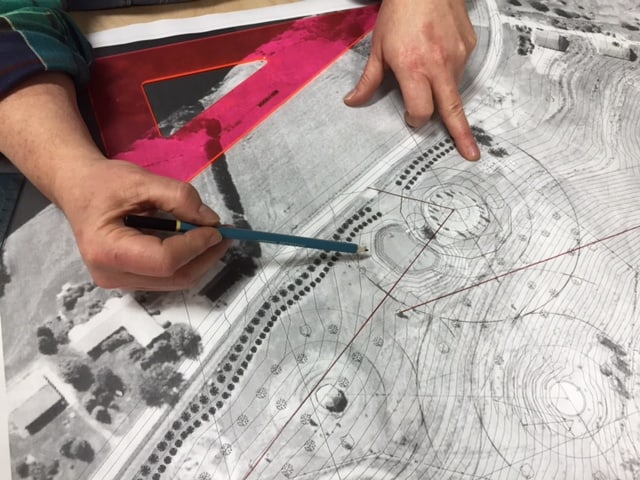
- A narrative and a full set of hand-drawings created.
- Timeline for implementation.
- Some areas that have been addressed for students and clients include:
- Transitioning from chemical to organic agriculture
- Broadacre permaculture design for farms and agroforestry systems
- Farm planning and implementation
- Small farm business planning
- Backyard garden education, planning and implementation
- Food forest and agroforestry planning and development
- Holistic Management for animals: Rotational grazing and grazing planning,
- Silvopasture
- Alley cropping
- Keyline analysis and design and earthworks for water management
- Crop selection
- Soils and fertility
- Biodynamic, Biointensive, Masanobu Fukuoka, Organics, Permaculture Systems
- Infrastructure and the built environment (natural building)
- Sacred number and geometry as a basis for design

Meet the Hosts
Lead Instructor
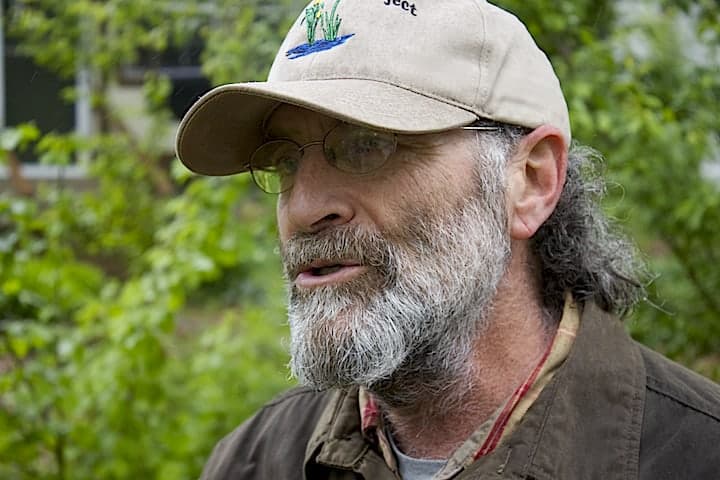
Wayne Weiseman
Wayne is a renowned permaculture teacher, designer, consultant and author, backed by years of experience as a farmer and builder. Certified in teaching by the founder of Permaculture, Bill Mollison, Weiseman has taught hundreds of courses and created master plans for properties around the world.

Master Craftsman
Paul Frank
Paul is a furniture maker, architect and builder, with more than 70 unique structures in his portfolio. Over 40 years, Paul has developed his 18 acre property and home as an integrated ecological venue for the cultivation of life skills. Today the land functions as the Center for Lost Arts under the direction of Paul’s wife, Bonnie Burton.