
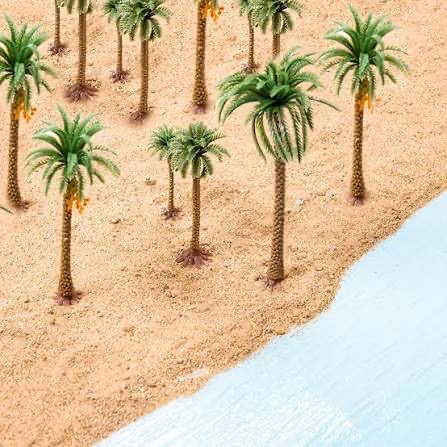
I came across a peer reviewed study 20+ years ago where some crazy folks got a grant to put, I crud you not, plastic palm trees in the middle of the Sahara desert to see the outcome. Their hypothesis was that the surface layer and third dimensional construct of the fake palm fronds would accumulate enough moisture that it would drip down into the soil and start life. Well, it worked. I can’t find the study, but let’s think about this. The main problem is a desert, especially the Sahara (sand dunes), is that there isn’t much surface area or leaves to keep and hold moisture, it’s just thousands of acres of sand. Now, if you put a bush, it’s likely not going to survive. If you put out a plastic tree made from recycled materials that has the surface area to mimic a live plant, what will it do. Turns out, it did wonders. Within a couple years, the plastic trees collected enough water to drip onto the sand and plants started to grow. Life started.
Think about it this way, a leaf has trichomes and/or hairs to create a wind buffer to reduce evapotraspiration off the leaf surface. Those hairs are there to minimize ET. Some other examples in large scale farming operations (wheat fields) in areas that are low precipitation (12″-18″) but high wind have moved towards stripper head combines leaving 12″ stubble that help the ET but also help evenly distribute what snow does fall. This is essentially like the hairs on a leaf. Now, think about this in a desert situation with no prospect of being able to grow anything, but the potential of being able to harvest water from the air. This is where the plastic trees come in. It might sound silly or blasphemous, but think about it. Putting out a temporary forest of plastic trees to harvest water from the atmosphere to help grow soil and germinate seeds that have long been dormant. I’m not intending this as a joke, but there is potential to re-green the desert with plastic trees.
Today, as an example. Yes, I’m on the Palouse. We usually get a bunch of rain. But this morning, the farm fields that surround me are moon scape. Our property has a lot of trees. What happened with that freezing fog? It all accumulated on the pine needles and when the sun hit it we got rain. Did that happen in the farm field moon scape? NO! Three dimensional surface area for moisture control and harvesting is what happened in the pines.
There are also other benefits to having a 3D type farm operation. The pines. Not only are they going to have the water harvesting capability… or even hedgrows on contour, but i’ll keep those to another post. The pines are going to keep heat allowing for the establishment of more frost sensitive trees. It’s been well established that in northern climates when establishing particular deciduous fruit trees, conifers are planted around them until they get to bearing age (5-10years). This helps with warmth, a buffer to wind and even water distribution.
Here’s a vid of this morning of getting rain from the pines of frozen fog melting off. The moon-scape farm field did not get the moisture accumulation that our property did. Even some contour multi-purpose hedgerows in the moon-scape farm fields would have added quite a considerable amount of ‘precipitation’.
So, think again about planting plastic trees in your desert environment. You might end up growing more than you would expect.
As always. Plant on!
__________________________________________________________
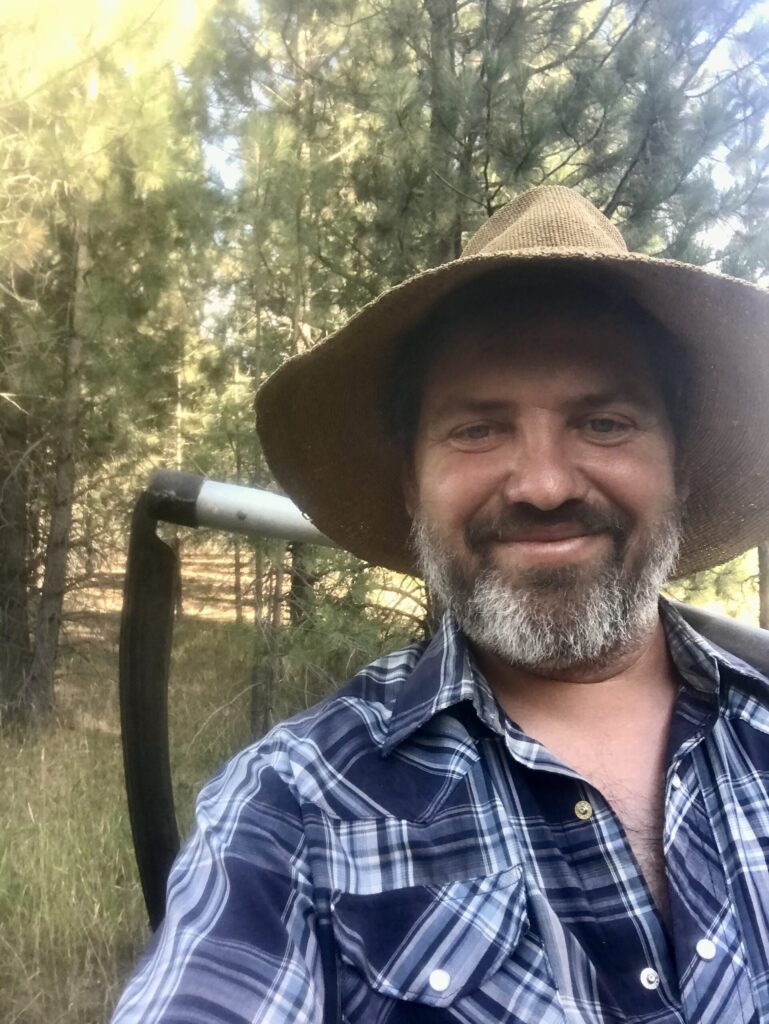 . Patrick Rahilly, founder of Pinecrest Permaculture LLC, began with his roots in a 5th generation farming and ranching family coupled with a love of the outdoors and spending time in the wilderness. Observations of nature and natural ecological systems came naturally with the writings of John Muir having a large impact in life path. Formal studies in undergraduate, graduate and post graduate work were focused in wildland soils, ecology, botany, wetlands, water resources and agroforestry. Patrick received Permaculture Design Certification in 2021 with instructor Alan Booker. In 2022, Pinecrest Permaculture was formed. Primary focus of design work revolves around design of small homesteads coupled with habitat restoration. Patrick’s diverse background from youth, to formal training and love of the land has aided in a unique perspective of permaculture design. He strives to create self regenerative systems that mimic natural ecological systems.